

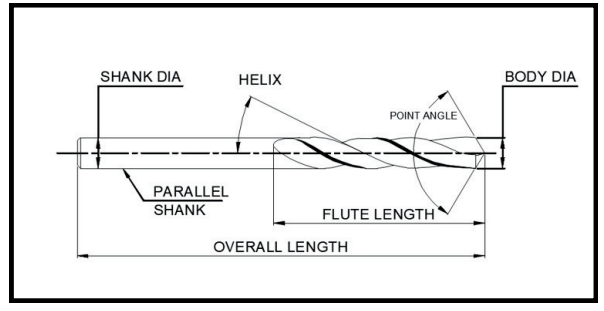
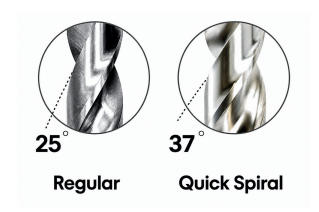
DRILLS DIFFERENT HELIX AND THEIR USES
25° Regular Helix
37° Quick Spiral
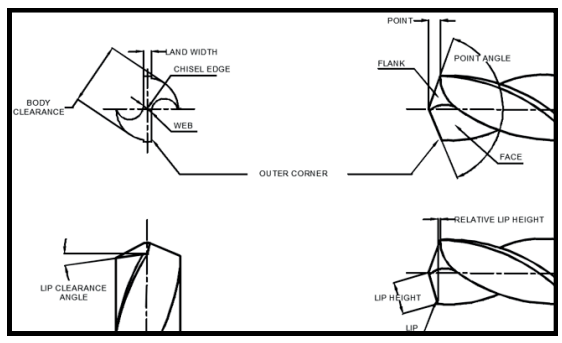
1. GENERAL PURPOSE DRILL
The 118° drill point is the most commonly used drill point. It will give satisfactory results in a wide variety of materials. This point style is supplied on all of our standard special drills unless specified otherwise, except for Spot Drills
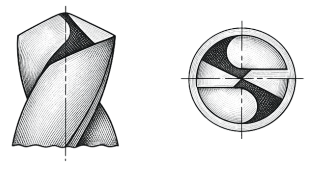
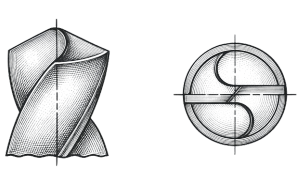
2. SPLIT POINT
118° or 135° split points are self-centering drill points that require less torque and thrust in hand or machine drilling. This point helps break up chips in deep-hole drilling and is an excellent choice when used on drills for CNC equipment.
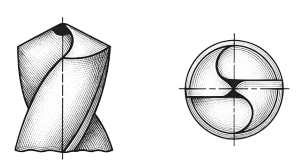
3. NOTCH THINNED POINT
This particular point style was developed for use in heavyduty drilling applications. It produces excellent results in drilling high-tensile alloys and steel forgings.
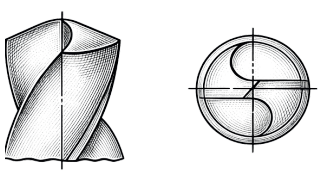
4. 135° POINT
Since the 135° drill point has a shorter cutting lip than a conventional 118° point and less lip relief, it has the necessary strength to drill tough, hard material. This point style can reduce or minimize burr break on breakthrough in many applications.
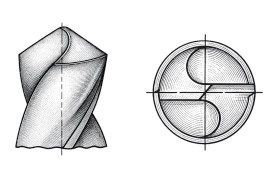
5. 90° POINT
The 90° drill point angle is most commonly used in wood, plastic, and low-density non- ferrous metals. This point will dramatically reduce cracking in drilling plastics. This point is also excellent for accurate spotting. All our standard spot drills are manufactured with this point style.
Proper drill selection, correct drilling conditions, and suitable machining parameters are essential for achieving accurate holes, longer tool life, and improved productivity.
The flute design, web thickness, and helix angle of a standard twist drill are suitable for drilling a wide range of engineering materials producing semi-continuous chips.
Drill rigidity plays an important role in drilling performance. A shorter flute length provides higher rigidity, reducing vibration, deflection, and improving hole accuracy. Long drills should be properly supported and used only when required.
For difficult-to-machine materials or applications with limited workpiece rigidity, Heavy Duty Drills with Thick Web, Split Point, or Web Thinning are recommended to reduce thrust force and improve drilling stability.
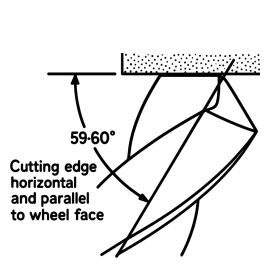
The web thickness gradually increases from the drill point towards the flute run-out area. During point thinning, the web should be reduced to approximately 10% of the drill diameter by using a grinding wheel with half the flute width. Excessive web thinning should be avoided, as it can weaken the drill and may lead to web splitting or breakage
Grooves can be ground across the cutting face using a thin, radiused grinding wheel to enhance chip breaking. When machining conditions permit, a lower cutting speed combined with a higher feed rate can help produce shorter, discontinuous chips, resulting in improved chip control and machining performance.
The standard 118° point angle is maintained over the inner half of the cutting lip, while the outer half is ground to 90° to form a reinforced cutting edge. This double-angle geometry strengthens the drill corners and helps minimize premature wear and edge damage, particularly when machining abrasive materials such as cast iron.
A wider point angle, up to 140°, is suitable for drilling high-strength and work-hardening materials. The modified point geometry forms concave cutting lips, reducing corner loading and providing smoother cutting action. For challenging materials and severe machining conditions, application-specific drill designs are recommended for improved tool life and performance.
Grinding the flute face along the cutting lip can reduce the effective helix angle, making the drill more suitable for machining brittle materials. This correction can also be applied to eliminate convexity in the cutting edges. During grinding, care should be taken to preserve the circular land. The resulting flat cutting edge is particularly effective when using a two-flute drill to enlarge or open an existing hole.
Point angles as low as 60° are suitable for drilling brittle materials such as Bakelite, helping to minimize chipping and flaking as the drill breaks through the workpiece. When applied to standard drill geometries, such acute point angles result in convex cutting edges, as described under point correction.
For thick-web, heavy-duty drills, the chisel edge can become excessively wide, making conventional web thinning ineffective. A split-point geometry creates additional cutting edges at the drill center, reducing thrust force, improving centering, and providing smoother, more efficient drilling performance.
| PROBLEM (INDICATION) | POSSIBLE CAUSES | RECOMMENDED REMEDIES |
|---|---|---|
| Drill breaks |
|
|
| Cutting lips chip |
|
|
| Outer corners breakdown |
|
|
|
Cracks in cutting lips |
|
|
| Tang breaks |
|
|
|
Drill breaks when drilling brass |
|
|
| Drill splits up center |
|
|
|
Drill will not enter work |
|
|
| Rough Hole |
|
|
| Oversize Hole |
|
|
|
Unequal chip size (one flute to other) |
|
|
|
Chips change while drilling |
|
|
|
Drill corners burning (blue-black colour) |
|
|